


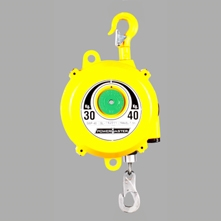
Manufacturing of automobiles consists of repetitive processes, which require operators to manipulate various tools such as welding guns and air-operated and electrical tools during their work shift. Manual manipulation of these tools for a long time makes manipulation difficult. In this respect, the use of a spring balancer assists because it hangs the tool suspended from an overhead suspension point and counterbalances its weight.
How Spring Balancers Support Automotive Production
During assembly, workers must access tools seamlessly from various positions and angles, requiring suspended equipment to reliably retract once released.
A spring balancer uses an internal spring and wire rope mechanism to counterbalance the load. The wire rope extends to provide the required reach during tasks, allowing operators to pull down, operate, and retract tools with minimal physical strain.
Proper spring tension adjustment is essential to match the exact weight of the suspended tool for smooth operation.
Key Applications in Automotive Manufacturing
Welding and Body Assembly
Welding booths typically require the use of tools that must be repeatedly moved between the welder and the vehicle body.
The welding gun that is attached to the spring balancer is easily accessible, but at the same time, it is not on the floor. The worker can pull the gun towards the work zone and place it there without lifting it entirely during the whole procedure.
Pneumatic and Electric Tool Handling
Auto manufacturing assembly lines utilize a variety of power tools to facilitate quick fastening, drilling, etc. Suspension of such tools may make them readily available at fixed work stations.
Such tools include:
- Nut runner and impact tools
- Air screws
- Electric drills
- Grinders
- Hand-held assembly tools
Instead of always putting down and picking up the same tool, workers can just leave it suspended and pull it down whenever needed.
Repetitive Assembly Operations
Many activities in automotive manufacturing processes follow the same pattern during an entire shift. It is likely that the operators have to handle the same tool many times when working on some parts and assemblies.
The spring balancer ensures that the tool remains positioned either above or next to the operator’s station, which helps to eliminate unnecessary motions. The capacity and stroke required also depend on the actual tool weight and operator’s work zone.
Factors to Consider When Selecting a Balancer
Every automotive balancing station has different needs. Manufacturers should consider the entire application, including:
- Load capability: Determine tool weight.
- Wire-rope travel: Cover the working range.
- Mounting: Ensure proper overhead support.
- Tension spring adjustment: Follow manufacturers’ instructions.
- Conditions of use: Consider the operating environment.
- Capacity: Choose the correct capacity.
Safety Features for Suspended Tools
While spring balancers provide essential mechanisms like safety locks, drum locks, tension indicators, and wire-arresting features, operators must still follow proper installation and operating guidelines to ensure complete workplace safety.
Conclusion
It all comes down to the right balancer based on the type of tool, load capacity, and travel that is needed. When we speak of a situation where there is a load within the capacity mentioned, a spring balancer 20kg could be used as long as the technical requirements are similar to the workstation requirements.
When automotive companies use suspended tools for welding, fastening, and repetitive assembly processes, Spring Balancers offers industrial tools that meet various load and travel demands.













Leave a Reply