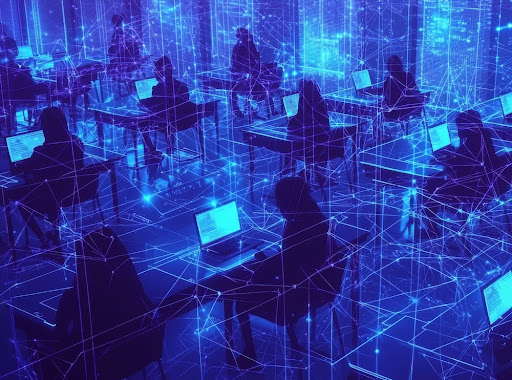
There has been an increase in the development of Artificial Intelligence (AI) and Virtual Reality (VR) technologies due to which many sectors, including healthcare, entertainment and manufacturing has evolved.
Education is no such exception to such developments. Nowadays, classrooms have progressed by introducing digital tools that help educators provide interactive and personalized learning experiences.
With all these developing revolutions present, are Pakistani classrooms ready to embrace AI and VR? Is this really the future of education or just an appealing fantasy?
In this blog, we will look at how AI and VR benefits the Pakistani classrooms along with the potential challenges of using such technology in Pakistani classrooms.
What AI Brings to the Classroom
AI in education refers to the use of machine learning and data processing in order to improve teaching and learning experiences. Below are some ways AI is making a difference:
-
Personalized Learning
AI can help individuals’ performance in real time and create learning content accordingly.
This allow struggling students to receive more customized support while advance learners can more ahead at their own pace.
This addresses the “one-size-fits-all problem in traditional classrooms.
-
Automated Administrative Tasks
AI tools automate repetitive tasks like grading, tracking attendance and manage student data.
This automation allows teachers to focus on mentoring rather than being stuck in the paperwork.
-
Intelligent Tutoring Systems
AI-powered tutoring platforms provides extra help to students outside of school hours.
These systems can provide immersive human tutoring experiences by answering questions, offering explanations along with correcting mistakes.
The Role of Virtual Reality in Pakistan
VR create an immersive environment where students can explore concept through visual and sensory experiences.
This can be seen as transformation in Pakistani classrooms where rote memorization often exists.
-
Immersive Learning Ecosystem
With VR, students can visit historical landmarks, conduct science experiments as well as explore human anatomy without even leaving the classroom.
This will provide a better engagement and retention of information.
-
Safe Simulations
VR is also ideal for subjects like chemistry, biology or engineering as real life experiments would be too dangerous or expensive.
It allows students to practice in a risk-free environment.
-
Inclusive Education
VR is a radical development for students with disabilities.
For example, VR platforms can be customized to assist students who have visual or hearing impairments and giving equal access to quality education.
The Role of Academic Support in the AI Era
As AI and VR tools are introduced in the educational journey, students are increasingly looking for academic support that helps them keep up with new expectations.
Many students seek assistance from Professional Essay Writers to help them meet writing standards and understand complex topics.
Even though technology can help in research and content generation, there is still a need for human guidance that provides quality and originality to the work.
Students need to know learning about the balance between tech and expert input during such transitional phase.
Ground Realities in Pakistan
Even with all of these possibilities, implementing AI and VR in Pakistani classrooms has its own challenges:
- Limited Infrastructure: Many public schools lack basic digital resources like reliable internet or computers.
- Teacher Training Gaps: It is important for teachers to be tech-savvy while introducing AI and VR into their classrooms. As of this moment, many training programs are still in development.
- Cost Constraints: VR headsets and AI learning systems calls for heavy investment, which are not feasible for many government schools.
- Digital Divide: In terms of technology access, there is a significant gap between urban and rural areas.
Such challenges portrays that while technology exists, its adoption is still a work in progress.
Is There Any Progress?
Yes! Pakistan has shown positive steps toward digital education. Those include:
- Private institutions in urban areas have begun experiment with VR lessons in subjects such as science and geography.
- The Punjab IT board introduced digital classrooms in selected schools.
- AI tools are utilized for grading and assignment tracking in various universities and online learning platforms.
Subsequently, there has been growing awareness among students and parents about the potential of such technologies that sparks the demand for innovation in education.
Future or Fantasy? – Final Thoughts
AI and VR are not meant to replace teachers at any cost but to empower them.
These tools in Pakistani classrooms are not entirely fantasy but are not mainstream future yet!
They still exist in a transitional phase where early adoption is happening in pockets mostly in private institutions. In order to make these technologies a national standard, huge investment, teacher training and infrastructure development are essential.
With the right policies and collaborations between public and private sectors, AI and VR can redefine the educational experience in Pakistan.