


My cousin runs a small property management company. Two years ago she paid a freelance developer to build her a tenant communication app. It launched, worked reasonably well for about eight months, then an iOS update broke the notification system and nobody could figure out why. The developer had moved on. She had no documentation, no handover notes, no idea where to even start diagnosing it. The app sat broken for four months before she gave up and went back to email.
That story isn’t about a bad app. The app was fine. It’s about what happens when a build ends at launch and nobody planned for what comes after.
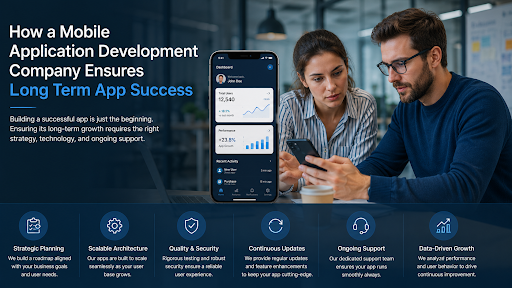
This is the gap a serious Mobile Application Development Company fills not just shipping something that works on release day, but building and supporting something that keeps working, keeps improving, and keeps serving the business as conditions around it change. Most conversations about app development focus almost entirely on the build. The part that determines whether an app actually succeeds long-term barely gets mentioned until something breaks.
Here’s what that looks like in practice.
Launch Day Is the Beginning, Not the Finish Line
There’s a version of app development where the relationship between a business and a development partner ends the moment the app goes live. The code gets handed over, the developer moves to the next project, and the business is left holding something they don’t fully understand, hoping nothing changes.
That model works fine until the first iOS major release. Or until user behavior in production turns out to be genuinely different from what anyone planned for. Or until a security vulnerability surfaces in a third-party dependency nobody’s been monitoring. Any of those things can happen within the first ninety days of a live app, and teams without a clear post-launch plan scramble badly when they do.
Long-term app success starts with treating launch as a transition point rather than an endpoint. The work shifts after launch, it doesn’t stop.
What Real Post-Launch Support Actually Involves
Support gets talked about in vague terms during sales conversations. “We’ll be there if anything breaks.” That’s not a support plan, that’s a reassurance. The difference between vague reassurance and actual post-launch support is specific and meaningful.
Operating system updates from both major mobile platforms arrive regularly and they break things in ways that are sometimes predictable and sometimes genuinely surprising. A development partner paying attention to upcoming platform changes can address compatibility issues before users encounter them rather than after. A partner who only responds reactively waits for the one-star reviews to arrive first.
Security patches matter independently of feature work. Third-party libraries and dependencies that worked fine at launch accumulate known vulnerabilities over time, and an app that nobody’s actively maintaining against those vulnerabilities is quietly becoming a liability without anyone noticing. Monitoring this isn’t glamorous work. It’s the kind of thing that only gets noticed when it’s been neglected for too long.
Bug triage is an ongoing function, not a post-launch sprint. Real users find edge cases that no amount of pre-launch testing fully surfaces, because real users do things in sequences and combinations that test plans never fully anticipate. Having a clear process for how bugs get reported, prioritized, and fixed determines whether those edge cases get quietly resolved or quietly accumulate into the kind of user experience that drives down ratings over months.
Iteration Based on What Real Users Actually Do
The product that ships on launch day is always a hypothesis. What users actually do with it is the experiment that tests that hypothesis, and the results are almost always at least partially surprising.
Maybe a feature the team was proud of gets ignored almost entirely because users found a different workflow that serves the same need. Maybe a screen that seemed simple creates genuine confusion for a consistent percentage of new users. Maybe a use case nobody planned for emerges as the most common thing people actually use the app for.
None of this is failure. It’s information, and it’s worth more than anything a pre-launch focus group would have told you, because it’s real behavior from real users making real decisions in their actual daily lives. A development partner who knows how to read this data and translate it into meaningful product decisions is one of the more valuable things a business can have in the year after launch.
The apps that compound in value over time are the ones being actively shaped by this feedback loop. The ones that stagnate are the ones where the product decisions after launch are based on whatever the original plan said rather than what the data actually shows.
Platform Evolution Is Constant and Can’t Be Ignored
Apple and Google don’t hold still. Both platforms ship significant updates regularly, and with each update come new capabilities, new design conventions, and occasionally deprecated APIs that apps depending on them need to address.
An app that was well-built three years ago and hasn’t been touched since is showing its age in ways that users may not consciously articulate but absolutely notice. Interaction patterns that were standard a few years ago have been replaced by newer conventions that feel more natural on current devices. Features that once required workarounds are now available natively and can be implemented more cleanly. Visual styles that felt current at launch can feel dated against the design language of the platform’s current generation.
Staying current with platform evolution isn’t a cosmetic concern. Users who experience an app that feels behind the platform often don’t complain directly they just quietly use it less, and eventually stop.
Scaling the Technical Foundation as the Business Grows
An app built for a few hundred users is often structurally different from one that needs to handle tens of thousands. The database queries that were perfectly fast with a small dataset can crawl when real data accumulates. The architecture decisions that made sense at launch can create bottlenecks at scale that require real structural work to address.
A development partner thinking about long-term success builds with some awareness of where the business is likely to go, not just where it is right now. That doesn’t mean over-engineering an MVP that’s a different kind of mistake but it does mean avoiding the specific shortcuts that are cheap in week two and expensive in month eighteen.
When a business grows faster than anyone planned for, the apps built on thoughtful foundations tend to scale with far less drama than the ones where every early decision optimized purely for speed of initial delivery.
The Relationship Structure That Actually Supports Long-Term Success
All of this requires a relationship structure between a business and its development partner that’s different from a project engagement. A project ends. A product doesn’t.
What that means practically: regular check-ins that aren’t tied to a specific deliverable, so emerging issues get caught before they become urgent. A shared understanding of the roadmap far enough ahead that technical decisions today don’t block product goals six months from now. Clear ownership of the ongoing maintenance responsibilities so nothing falls into a gap between “that was the project” and “that’s your problem now.”
This isn’t a complicated arrangement to set up. It does require both parties to treat the relationship as ongoing rather than transactional from the start, which is easier to establish before a project begins than to retrofit after a launch.
What Separates Apps That Last From Apps That Don’t
Looking across the apps that genuinely succeed long-term, not just at launch but a year, two years, three years in, the pattern is consistent. They’re being actively tended. Someone is paying attention to what users actually do. Someone is staying ahead of platform changes rather than reacting to them. Someone is making product decisions based on real data rather than original assumptions that may or may not have held up.
None of that is automatic. It requires a development partner who was thinking about year two on day one of the build, not just about getting to launch day as cleanly as possible.
The apps that get abandoned, broken and unreplaced in app stores where users still encounter them and leave confused reviews, almost always share the same story underneath. A build that ended at launch, a relationship that was transactional rather than ongoing, and a business that discovered too late what it actually costs to maintain something people depend on.
That’s a solvable problem. But it needs to be part of the plan from the beginning.











Leave a Reply