



Enterprises often treat infrastructure automation and application support as two separate concerns, managed by different teams with different priorities. In practice, the fastest and most resilient organizations blend devops managed services with application managed services into a single, coordinated operating model — one where releases ship faster and applications stay healthier because the people managing pipelines and the people managing production are working from the same playbook.
This is not just an organizational preference. The complexity of modern software architectures — microservices, containers, event-driven systems, multi-cloud deployments — makes it nearly impossible for a fragmented operating model to keep up. When pipeline engineers and production support engineers share dashboards, tools, and incentives, incidents resolve faster and releases become more predictable.
The Cost of Keeping DevOps and Application Support Separate
When CI/CD pipelines are managed independently of application support, incidents get diagnosed slower. A performance issue in production might trace back to a pipeline misconfiguration, but if the two functions do not share visibility, resolution stalls in finger-pointing rather than root-cause analysis. Meanwhile, customers and business teams pay the price in outages and delays.
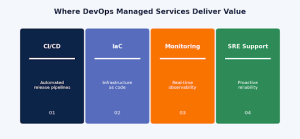
Devops managed services solve half the problem — automating build, test, and deployment so changes ship quickly. But without application managed services closing the loop on post-release monitoring, patching, and support, enterprises lose the feedback signal that makes continuous improvement possible. Combining the two produces a virtuous cycle that neither can achieve alone.
Shared Observability as the Connective Tissue
Unified dashboards spanning infrastructure metrics, application performance, deployment history, and business KPIs let both teams see the same truth. This shared view dramatically cuts mean time to resolution and eliminates the political friction that comes with separate tooling stacks each team defends as their own.
SLAs That Reflect the Full Lifecycle
Rather than separate service-level agreements for uptime and for release velocity, mature managed services contracts tie both together — incentivizing stability and speed simultaneously instead of trading one for the other. This alignment ensures no team optimizes for its own metric at the expense of the overall system.
Automating the Operational Backbone
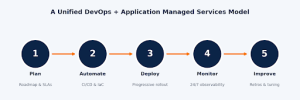
Devops managed services bring infrastructure-as-code, automated testing, and progressive delivery techniques like canary releases and blue-green deployments — reducing the blast radius of any single change. These capabilities let enterprises release more often with confidence, rather than batching risky changes into rare, high-stakes deployment windows.
Paired with proactive application managed services — 24/7 monitoring, patching, capacity planning, and incident management — enterprises get a system that not only ships changes quickly but also catches problems before customers do. Predictive alerting and AIOps techniques further reduce the operational load by surfacing anomalies before they escalate into visible incidents.
- Infrastructure-as-code for repeatable, auditable environment provisioning across every region
- Automated rollback triggers tied directly to real-time application health metrics
- Proactive capacity planning driven by usage-trend analysis rather than gut feel
- Centralized incident management spanning both pipeline and application layers
- Runbook automation so common recovery tasks execute in seconds rather than hours
- Continuous security scanning integrated into every pipeline stage without slowing releases
AIOps and the Next Evolution of Managed Services
The next wave of devops managed services and application managed services is heavily influenced by AIOps — using machine learning to correlate signals from thousands of monitored components and surface the real root cause of an incident. Instead of paging on-call engineers for every spike in a metric, AIOps engines cluster related alerts, suppress noise, and highlight the changes most likely responsible for a problem.
This shift transforms the day-to-day work of support engineers. Instead of chasing false positives, teams spend more time on genuine investigations and structural improvements. It also unlocks the ability to run leaner support teams without sacrificing coverage — a critical advantage as enterprises operate more services across more environments than ever before. Leading application managed services providers now bundle AIOps into their standard offerings rather than treating it as an optional premium tier.
Freeing Internal Teams to Focus on Innovation
Perhaps the most underrated benefit of combining these managed services is what it frees internal teams to do instead: build new features, explore new markets, and focus on strategic technology decisions rather than firefighting. When operational toil is absorbed by a mature managed services partner, engineering leaders reclaim the mindshare needed to drive genuine innovation.
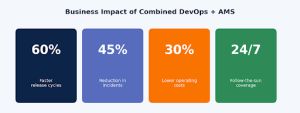
Enterprises that outsource the operational grind to a capable partner consistently report faster release cadences, improved engineering morale, and lower attrition among their most experienced engineers — since those engineers spend less time on repetitive operational tasks and more time on genuinely interesting technical problems.
Best Practices for a High-Performing DevOps + AMS Model
Enterprises that get the most out of combining devops managed services and application managed services share a set of practical disciplines that keep the model strong over time.
- Publish a joint scorecard covering release velocity, incident MTTR, and change failure rate
- Rotate engineers between pipeline and support roles so empathy and knowledge flow both ways
- Invest in automation for repetitive support tasks so engineers focus on genuine engineering work
- Run joint retrospectives after major incidents that include both DevOps and AMS teams from day one
Actionable Insights for Enterprise Leaders
- Consolidate monitoring dashboards so DevOps and application support teams share one source of truth from day one
- Define combined SLAs that measure both deployment velocity and system stability together, not separately
- Automate rollback triggers based on real application health signals, not just deployment success indicators
- Review incident postmortems jointly across pipeline and application teams to close feedback loops quickly
- Standardize runbooks and playbooks so knowledge is not trapped in individual engineers’ heads
- Use both devops managed services and application managed services as a lever to accelerate cloud adoption, not just to reduce operational cost
Conclusion
Devops managed services and application managed services are stronger together than apart. Enterprises that unify these functions under a coordinated managed services strategy consistently achieve faster releases, fewer production surprises, and internal teams that can finally focus on innovation instead of operational firefighting. In a landscape where uptime and speed are both non-negotiable, this integrated approach is no longer a luxury — it is quickly becoming the operating standard for competitive digital businesses.









Leave a Reply