


Introduction
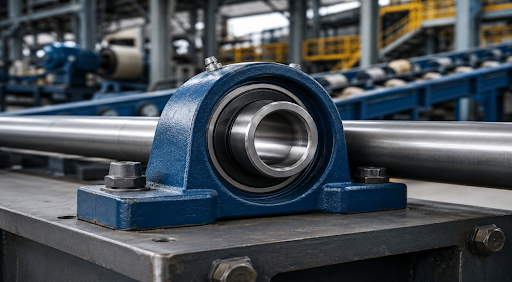
Pillow block bearing failure gets blamed on the bearing itself more often than the evidence actually supports. Pull the failure data across a reasonable sample of premature failures in industrial service, and a large share trace back not to a defective bearing but to something in the surrounding installation and operating environment that the selection process never accounted for. Misalignment tolerance that got assumed rather than measured. A mounting surface that looked flat and wasn’t, at least not to the tolerance the application actually needed. A relubrication interval copied from a generic maintenance schedule instead of calculated against actual operating temperature and speed. None of these show up on a bearing datasheet, and none of them get caught by simply matching load rating and bore size against the shaft.
Pillow block bearings get specified, in a lot of procurement processes, primarily against static and dynamic load rating, bore diameter, and housing material, treated as a largely interchangeable commodity component once those numbers line up. That approach works fine for a genuine share of low-consequence, low-duty applications. It fails, often in ways that take months to show up as a pattern rather than an isolated incident, once the application involves any of the factors that follow, none of which show up prominently on a standard product datasheet.
Shaft Alignment and the Limits of Self-Aligning Housing Design
Spherical roller pillow block bearings are marketed, correctly, as self-aligning, and that self-aligning capability genuinely accommodates a meaningful degree of shaft misalignment without transmitting damaging load into the bearing. What gets misunderstood is the actual tolerance range that self-alignment covers. Most spherical pillow block designs accommodate somewhere in the range of 1.5 to 3 degrees of misalignment, a figure that varies by specific bearing series and manufacturer, and installations that exceed this range don’t fail gracefully. They transmit edge loading into the roller elements that the self-aligning geometry was never meant to absorb past its designed range, producing a fatigue pattern that looks, on initial inspection, like a bearing quality problem rather than the alignment problem it actually is.
Laser alignment tools have become standard practice on critical rotating equipment specifically because visual or straightedge alignment checks routinely miss misalignment well within the range that shortens bearing life meaningfully, even where the misalignment sits within what the self-aligning housing can technically accommodate without immediate failure. Accommodating misalignment isn’t the same as eliminating its effect on fatigue life, a distinction that gets lost when self-aligning capability is treated as a substitute for alignment discipline rather than a tolerance buffer against minor, unavoidable deviation.
Mounting Surface Condition and Base Rigidity
A pillow block housing bolted to a mounting surface that isn’t genuinely flat gets distorted slightly as the mounting bolts get torqued down, and that distortion transmits directly into the bearing bore, producing a preload condition the bearing was never designed to run against. This effect is subtle enough that it rarely shows up during installation and commissioning. It shows up months later as reduced bearing life, and by that point the mounting surface condition is rarely the first thing investigated, since the bearing itself is the more visible and more obvious suspect.
Base rigidity matters just as much as flatness. A mounting structure that flexes under load, whether from an underdesigned base frame or from vibration transmitted through the foundation, subjects the bearing to dynamic loading well above what the static installation condition suggested, a factor that matters considerably more for high-speed or heavy-load applications than for light-duty service where base flex has a proportionally smaller effect on actual bearing loading.
Lubrication Selection Against Actual Operating Conditions, Not Generic Schedule
Grease selection and relubrication interval get treated, on a lot of maintenance schedules, as a fixed calendar item, the same interval applied across a wide range of bearings regardless of actual operating speed, temperature, and load. This is one of the more consequential oversights in pillow block bearings maintenance practice, because relubrication interval calculated correctly depends heavily on operating temperature specifically. A bearing running at elevated temperature, whether from ambient conditions, from friction heat at high speed, or from proximity to a heat source elsewhere in the equipment, degrades grease at a meaningfully faster rate than the same bearing running at moderate temperature, and a fixed calendar interval that doesn’t account for this runs the bearing on degraded, ineffective lubrication for a portion of the interval without anyone realizing it.
Grease compatibility across relubrication cycles matters too, and gets overlooked more often than the lubrication interval itself. Mixing incompatible grease formulations during relubrication, particularly across different thickener types, can produce a grease mixture with meaningfully worse performance characteristics than either grease individually, a failure mode that’s entirely avoidable through consistent grease specification but that shows up regularly where maintenance sourcing changes over time without anyone flagging the compatibility question.
Seal Selection Against the Actual Contamination Environment
Standard contact seals, adequate for a clean or moderately dusty indoor environment, perform poorly against fine abrasive particulate, high-pressure washdown, or submerged and wet service, and a seal mismatched against the actual contamination environment allows ingress that degrades the grease and introduces abrasive wear into the raceway well before the bearing’s rated fatigue life would otherwise be reached. Labyrinth and taconite-style seals, designed specifically for heavy contamination and washdown environments common in mining, aggregate, and food processing applications, cost more than standard contact seals but deliver a meaningfully longer service life in these environments, a tradeoff that a purely price-driven seal selection frequently gets wrong.
The practical failure mode from seal mismatch rarely announces itself directly. Contaminant ingress accelerates grease degradation and raceway wear gradually, and the bearing typically presents as a general premature failure rather than a specific contamination signature, which means seal selection gets overlooked as a root cause even in failure investigations conducted after the fact.
Internal Clearance and Its Effect Under Thermal Growth
Bearing internal clearance, the small operating gap between rolling elements and raceway, is selected against expected operating temperature differential between the inner and outer ring, and getting this selection wrong in either direction produces a real performance problem. Insufficient clearance for the actual thermal growth the application produces results in the bearing running with excessive preload as temperature rises, generating additional friction heat that compounds the problem further. Excessive clearance, on the other hand, allows more internal movement than the application can tolerate, producing vibration and accelerated wear from that additional internal play. Standard clearance class works adequately for a wide range of general applications, but high-speed or high-temperature-differential service frequently requires a specific clearance class selected against the actual thermal condition, a detail that a bore-size-and-load-rating-only specification process routinely skips entirely.
Locking Mechanism Selection and Its Effect on Shaft Fit
Set screw locking, common on lower-cost pillow block bearings, secures the bearing to the shaft through direct point contact, which can produce localized shaft damage and, under vibration or load reversal, allows enough micro-movement between bearing and shaft to eventually loosen the connection. Adapter sleeve or concentric locking collar designs distribute the clamping force around the full shaft circumference rather than at discrete points, providing a more secure and more easily removable connection, particularly valuable for larger shaft diameters and higher-load applications where set screw point loading becomes a genuine long-term reliability concern rather than a minor installation detail.
This selection matters more in applications involving frequent load reversal or vibration, common in conveyor and material handling equipment, where the incremental loosening that set screw mounting is prone to over time compounds gradually into measurable shaft wear and eventual bearing looseness that a properly specified adapter sleeve mounting would have avoided from the outset.
Environmental Temperature Range and Housing Material Selection
Standard cast iron pillow block housings perform adequately across a wide ambient temperature range, but applications involving significant temperature extremes, either sustained high heat from process proximity or low-temperature outdoor service in cold climates, benefit from housing material and internal clearance selection matched specifically to that temperature range rather than a standard specification applied regardless of ambient condition. Thermal expansion differential between housing, bearing, and shaft, when not accounted for in the original clearance and fit selection, produces exactly the preload or excessive clearance problems described earlier, a connection that ties housing material selection directly back to the internal clearance discussion rather than treating the two as independent specification decisions.
Bringing These Factors Into the Specification Process
None of the factors covered here show up as a line item on a standard pillow block bearings datasheet, which is precisely why they get overlooked during a specification process built primarily around load rating and bore diameter. Building alignment tolerance verification, mounting surface flatness checks, application-specific lubrication scheduling, contamination-matched seal selection, thermal-condition-appropriate clearance class, and locking mechanism selection into the specification and installation process, rather than treating the bearing itself as the sole variable that determines service life, is what actually closes the gap between rated fatigue life and the service life a bearing delivers in practice.
Conclusion
Premature pillow block bearing failure is, in the large majority of documented field cases, a symptom of a mismatch somewhere in alignment, mounting, lubrication, sealing, internal clearance, or locking mechanism selection, rather than a defect in the bearing itself. Treating pillow block bearings as a simple commodity component, selected purely against load rating and bore size, consistently misses these underlying factors, and the operations getting reliable long-term service from this equipment are the ones evaluating installation and environmental conditions with the same rigor applied to the load calculation itself, rather than treating that installation and environment as a fixed backdrop the bearing simply has to tolerate.














Leave a Reply