


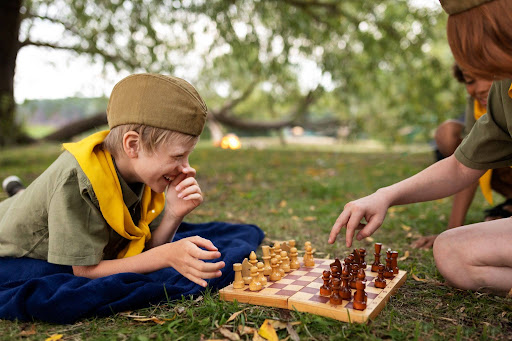
Winning a chess game often depends on noticing an opportunity before the opponent does. At the intermediate level, players begin moving beyond basic rules and learn to recognize tactical ideas that can change a position within a few moves. Intermediate chess classes introduce learners to recurring patterns, combinations, calculation methods, and practical decision-making, helping them understand not only what move to play, but also why a particular sequence can create an advantage.
Building Tactical Awareness Through Patterns
Tactics are rarely random. Strong players recognize recurring ideas and use them when the position creates the right conditions. Intermediate training introduces patterns such as forks, pins, skewers, discovered attacks, double attacks, deflections, and x-ray attacks. Students learn to identify the pieces involved, notice vulnerable squares, and understand what changes after each move.
This pattern-based approach makes calculation more organized. Instead of searching the entire board without direction, a player can ask whether a tactical motif is available. Repeated practice also helps common patterns become easier to recognize during real games.
Learning to Calculate Before Making a Move
A combination usually requires more than seeing one attractive move. Students must calculate what happens after the opponent responds. Intermediate lessons therefore encourage a disciplined thinking process: identify forcing moves, examine checks and captures, consider threats, and compare the resulting positions.
Puzzle sessions can reinforce this habit. A student may find a tactical idea, then calculate several responses before selecting the move. Over time, this develops patience and reduces impulsive decisions. The goal is to solve puzzles while building a repeatable method for analyzing positions.
Understanding Double Attacks and X-Ray Ideas
Double attacks are useful because one move can create two threats at once. A knight fork may attack a king and a valuable piece, while another tactical move can expose an attack along a file, rank, or diagonal. X-ray ideas require students to understand how one piece can influence a target through another piece.
These concepts teach players to look beyond what is visible. A piece that appears protected may actually be vulnerable after a tactical sequence changes the alignment of the board. Such exercises strengthen calculation and improve awareness of hidden relationships between pieces.
Combining Tactics With Opening Knowledge
Tactical opportunities often arise from opening mistakes. Intermediate students can therefore study opening traps while learning why particular moves work. Examples such as the Fried Liver and Legal’s Mate illustrate how development, king safety, piece coordination, and tactical threats can interact.
The purpose is not to memorize a long sequence without understanding it. Students can examine the position that creates the tactic, identify the opponent’s mistake, and learn how the combination develops. This approach helps turn opening knowledge into practice rather than purely theoretical.
Connecting Tactical Combinations to Strategy
Tactics become more powerful when players understand the position around them. A combination may win material, create an attack, or force a favorable exchange, but the resulting position still needs to be evaluated. Intermediate training therefore connects tactical calculation with ideas such as material balance, positional advantages, pawn weaknesses, and piece activity.
A best chess course for intermediate players should help students understand this connection. Winning a pawn is useful only when the player can recognize whether the resulting position is favorable. Likewise, a sacrifice should be evaluated according to the threats and compensation it creates.
Practicing Through Real Games
Real games provide context that puzzles cannot always provide. Students can review positions where a tactical opportunity was missed, identify the pattern involved, and calculate what could have happened. They can also examine successful combinations to understand how earlier moves prepared the tactic.
Game analysis makes learning more personal. Instead of solving an unfamiliar diagram, students study decisions from their own games. This can reveal recurring mistakes, such as overlooking defensive resources, calculating only one response, or attacking before completing development.
Developing Tactical Discipline
Strong tactical play requires discipline. Players need to check whether their intended combination actually works, whether the opponent has an intermediate move, and whether the final position is safe. Training can introduce habits such as asking what the opponent threatens before calculating an attack.
These habits are particularly valuable in competitive games, where time pressure can encourage rushed decisions. A structured routine helps players stay focused and calculate efficiently without spending excessive time on every move.
Using Puzzles to Strengthen Recognition
Regular tactical puzzles provide repeated exposure to familiar motifs. Students may solve positions involving forks one day and then work on pins, discovered attacks, or combinations on another day. Difficulty can gradually increase as they become comfortable with the underlying ideas.
The best chess intermediate classes in USA can use this progression to support learners with different levels of experience. A structured sequence allows students to revisit concepts while introducing increasingly complex positions, helping them build confidence without skipping important foundations.
Turning Tactical Knowledge Into Practical Skill
Knowing the name of a tactic does not guarantee that a player will find it during a game. Practical improvement comes from combining recognition, calculation, evaluation, and execution. Students need opportunities to apply tactical ideas in puzzles, training games, tournaments, and analyzed positions.
The best online chess academy can support this process by combining instruction with practice, feedback, study materials, and performance review. When learners repeatedly apply concepts in different positions, tactical knowledge becomes more flexible and useful.
Conclusion
Developing tactical ability requires more than memorizing individual moves. Players improve when they repeatedly identify patterns, calculate variations, evaluate consequences, and apply combinations in practical positions. Intermediate chess classes provide a structured environment for building these skills through puzzles, game analysis, and competitive practice, helping learners become more confident and thoughtful players as their chess understanding continues to grow.
For children seeking structured chess development, expert guidance, and engaging competitive learning opportunities, Chessbrainz offers structured chess learning for children through beginner, intermediate, advanced, and master-level programs. Its services include personalized online coaching, interactive lessons, tactical puzzles, study materials, game analysis, progress tracking, tournaments, and community sessions. Grandmaster-curated training and FIDE-rated instructors support children as they develop chess knowledge, strategic thinking, calculation skills, and practical tournament experience throughout their competitive chess learning journey.










Leave a Reply