


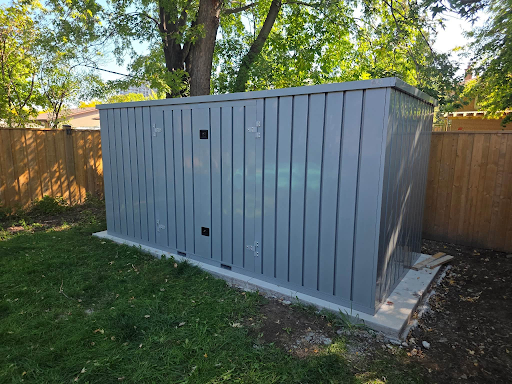
Storage requirements can become more complicated when one property needs to serve several tenants, businesses, departments, or categories of equipment. A single large storage bay provides capacity, but it does not always provide the separation and access control that multi-user environments require. A 19 foot multi compartment unit addresses this challenge by combining multiple individually secured storage spaces within one overall structure.
The configuration can be particularly useful for self-storage operators, apartment communities, commercial properties, and businesses that need flexible storage without constructing several separate buildings. The available model from My Yard Vault measures 19 feet long by 8 feet wide and 8 feet 6 inches high and contains four individual compartments.
What Is a 19 Foot Multi Compartment Unit?
A 19 foot multi compartment unit is a large steel storage structure divided into separate lockable sections. Instead of providing one shared interior, the design creates individual access points for different users or storage categories.
The current model listed by My Yard Vault contains four compartments, each providing approximately 265 cubic feet of storage capacity. Together, the compartments provide approximately 1,060 cubic feet of total capacity.
This arrangement allows several tenants or departments to use the same overall footprint while maintaining separate access and organization.
What Are the Main Dimensions?
The overall external dimensions are:
- Length: 19 feet
- Width: 8 feet
- Height: 8 feet 6 inches
- Number of compartments: 4
- Capacity per compartment: approximately 265 cubic feet
- Total capacity: approximately 1,060 cubic feet
- Individual door opening: 4 feet wide by 7 feet high
- Tare weight: approximately 4,200 pounds
- Maximum payload: 12,000 pounds
The listed floor load capacity is 200 pounds per square foot. These specifications make the unit suitable for a range of stored belongings, equipment, tools, supplies, and business inventory, provided the total weight remains within the manufacturer’s stated limits.
How Does the Multi-Compartment Design Improve Storage?
The primary advantage is separation. A conventional storage unit with one large interior requires users to share the same access area, while a divided configuration allows each compartment to operate independently.
For a self-storage operator, four compartments can potentially serve four separate customers within one structure. For an apartment complex, individual compartments could be assigned to residents. Businesses could use separate sections for tools, inventory, seasonal equipment, or maintenance supplies.
The design can also improve organization for a single property owner. Separating categories reduces the need to move unrelated items when accessing one particular group of belongings.
Why Is Individual Access Important?
Separate access is particularly valuable in multi-user environments. Each compartment has its own door and lock box, allowing users to access their assigned space without entering another person’s storage area.
This can help property managers establish clearer access arrangements. An employee, tenant, contractor, or customer can be given access to a specific compartment without necessarily receiving access to the other sections.
The listed unit includes four individual doors and four lock boxes, supporting independent access for each compartment.
What Is the Unit Made From?
The listed structure uses 14-gauge steel for the walls and 16-gauge steel for divider walls. Its floor uses marine plywood, and the exterior has a powder-coated finish. Available finish colors listed by the manufacturer include gray, beige, and green.
Steel construction can be useful for outdoor storage because it provides a durable enclosure for equipment and belongings. However, the appropriate installation location, site preparation, drainage, and local requirements should still be evaluated before installation.
How Does Ventilation Help?
Ventilation is an important consideration for enclosed outdoor storage. Temperature changes and moisture can contribute to condensation, which may affect stored items over time.
The unit includes eight ventilation units, providing dedicated ventilation for the compartments.
Good ventilation does not eliminate the need to store moisture-sensitive items appropriately, but it can support air circulation within the enclosed spaces.
Who Can Use a Multi-Compartment Storage Unit?
Several types of property owners and operators can benefit from this configuration.
Self-Storage Facilities
Self-storage operators can use multiple compartments to increase the number of rentable spaces without constructing an entirely separate structure for every customer.
Apartment Communities
Property managers can provide individual storage areas for residents. This can be useful where apartments have limited in-unit storage or where additional outdoor storage is needed.
Business Parks
Commercial properties can allocate separate compartments to different tenants for equipment, inventory, maintenance supplies, or operational materials.
Individual Businesses
A business with several categories of equipment can use the compartments to separate tools, supplies, inventory, and seasonal materials.
The manufacturer specifically identifies self-storage facilities, apartment complexes, and business parks among the potential applications for the unit.
Is It Easy to Relocate?
Portability can be an important consideration when a property owner’s storage requirements may change. The listed unit uses a flat-pack design and is described as relocatable. Its stated assembly time is approximately four hours, although actual installation time can vary according to site conditions, workforce, and preparation.
Relocatable storage can be useful for businesses that change sites or property managers who want the flexibility to reorganize their available space without constructing a permanent building.
What Should You Check Before Installation?
Before purchasing a 19 foot multi compartment unit, property owners should evaluate more than the unit’s internal capacity. Important considerations include:
- Available installation footprint
- Delivery and access route
- Ground or foundation requirements
- Local zoning and permitting requirements
- Required setbacks and property restrictions
- Drainage and surface conditions
- Security requirements
- Intended storage loads
- Accessibility for tenants or employees
- Future expansion requirements
The manufacturer’s specifications should be reviewed alongside applicable local regulations before installation.
Why Is Size Planning Important?
A 19-foot structure needs sufficient clearance not only for the unit itself but also for delivery, assembly, doors, walkways, and ongoing access.
Each compartment has an approximately 4-foot-wide door opening and 7-foot door height.
Property owners should therefore map the proposed installation area before ordering. Planning for future access is equally important; a unit that technically fits a property may become inconvenient if doors are blocked by vehicles, fencing, landscaping, or other structures.
Conclusion
A 19 foot multi compartment unit provides a practical way to combine substantial storage capacity with separate access and organization. Its four-compartment configuration can serve multiple tenants, residents, departments, or storage categories while keeping them within a single overall structure. For property owners evaluating a 19 foot multi compartment unit in ABQ, dimensions, access, site preparation, local requirements, security, ventilation, and intended use should all be considered before installation. A careful assessment of these factors can help ensure that the storage configuration fits both current requirements and future operational needs.







Leave a Reply